Cadence · Nonlinear & Multiphysics FEA Solver

Marc: Nonlinear Structural, Thermal & Multiphysics Reliability Analysis

Marc is a dedicated nonlinear finite element solver used to predict whether hardware survives real operating conditions — not just whether it performs. This page works through what the solver actually does, its core solution types, the workflow that connects them, and the industries that rely on each one, as a technical reference rather than a product pitch.

Solver ClassNonlinear, multiphysics finite element solver
DeveloperHexagon / MSC Software (Cadence portfolio)
Core Solution TypesNonlinear structural, contact, thermal-structural & electromagnetic coupling
Model ScaleA single winding or gasket cross-section to a full motor or transformer assembly
HistoryAmong the earliest commercial nonlinear FEA codes, in industrial use since the early 1970s
Overview

What Marc actually is

Marc is a dedicated nonlinear finite element solver, not a general-purpose linear structural code with nonlinear options bolted on. It is built from the ground up to solve problems where the relationship between load and response is not proportional — because a part deforms enough to change its own stiffness, because contact between components opens, closes, or slides during loading, or because the material itself yields, creeps, or stretches well beyond the linear-elastic range. GTECH ASIA has previously marketed Marc through three separate reliability use cases — EV motor reliability, electronic reliability, and transformer reliability — but underneath all three sits the same solver and the same core solution set, applied to different hardware.

What ties the three use cases together is that in every one of them, the electromagnetic or thermal design tool predicts how the device performs — torque, efficiency, temperature rise, losses — but stops short of predicting whether the hardware survives that performance over years of operation. Marc is positioned downstream of those tools: it takes the electromagnetic forces and temperature fields they generate and computes the resulting stress, deformation, contact pressure, and fatigue damage in the physical structure. A motor's electromagnetic model can confirm the torque curve is right without ever telling you whether the retaining sleeve holding the magnets in place will crack at operating speed — that's a structural question, and it's Marc's question to answer.

Because nonlinear problems are typically the hardest and slowest class of FEA to solve, Marc's architecture is built around getting through them efficiently: automatic contact detection instead of manually defined master/slave surfaces, automatic remeshing when large deformation distorts the original mesh beyond usability, and a domain-decomposition parallelization scheme that splits a model across processors for every phase of the solve. Structural results can be exported as DMIG files for direct compatibility with Nastran, or as Modal Neutral Files for use in Adams.

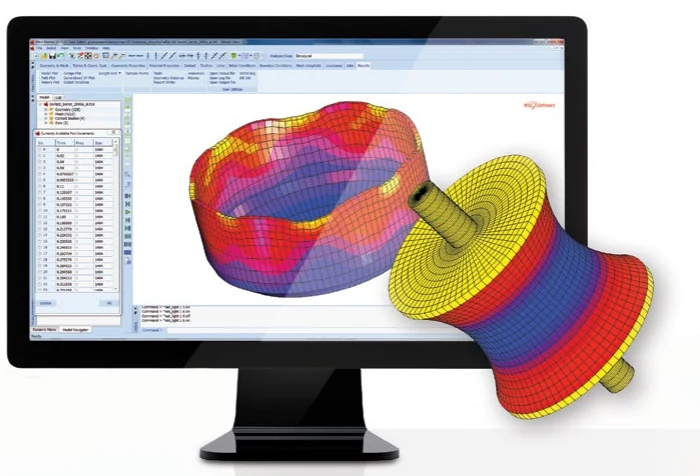
Marc pre- and post-processing environment showing nonlinear stress contours on two component models
Marc's integrated pre- and post-processing environment, showing nonlinear stress contours on a formed metal component and a large-deformation rubber-boot model.
Analysis Capabilities

Eight core capabilities, explained

Each capability below is a distinct solution class inside Marc. For each one: what it solves, why engineers reach for it, the industries that depend on it most, the results it produces, and the design decisions those results are actually used to make.

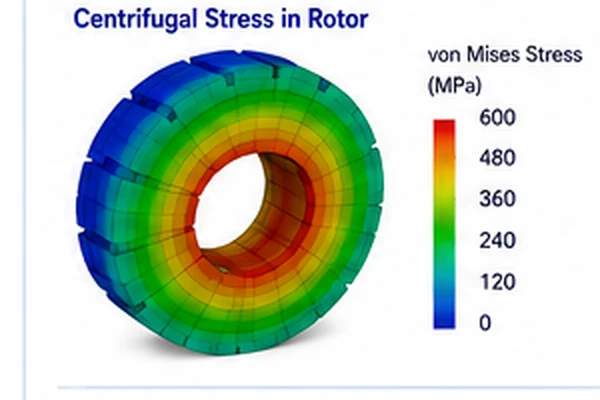
Centrifugal stress contour on a laminated rotor ring
Centrifugal stress on a laminated rotor ring — the kind of large-deformation, contact-rich problem a linear solve cannot represent accurately.
01

Nonlinear Structural Analysis

Nonlinear structural analysis is Marc's core discipline: an incremental, iterative solution procedure that updates geometry, stiffness, and boundary conditions as the structure deforms, rather than solving the whole load case in one linear step. This matters wherever the assumption behind linear statics — that deflections stay small and stiffness stays constant — breaks down, which in reliability work is often the normal operating case rather than the exception. A motor's retaining sleeve under centrifugal load, a transformer's winding under short-circuit force, or a snap-fit connector housing all deform enough, or contact enough, that a linear solve gives the wrong answer.

Typical Industries
Automotive EV powertrain, power electronics housings, transformer structural components, general industrial equipment.
Expected Outputs
Incremental load-response history, geometry-corrected stress and strain fields, deformation shape, convergence diagnostics.
Design Decisions Enabled
Setting safe operating limits — burst speed, short-circuit withstand force, housing wall thickness — based on how the structure actually deforms.
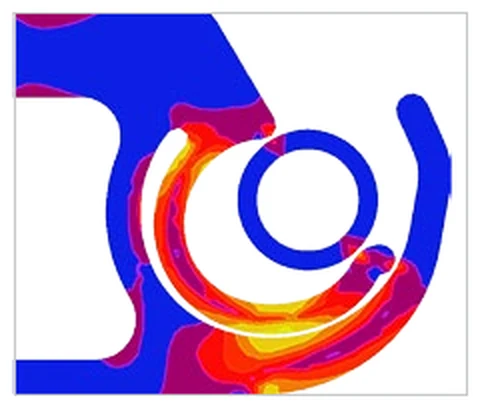
Stress contour on a curved bracket-and-ring contact interface
A contact-pressure result at a curved bracket interface — the mechanism behind nearly every assembly-level reliability question.
02

Contact & Assembly Simulation

Contact modeling represents how separate bodies actually interact — pressing together, sliding, separating, or transferring load only where they physically touch — instead of assuming everything is bonded. Marc automatically detects contact boundaries from CAD assembly geometry rather than requiring the analyst to hand-define master and slave surfaces, and uses a single algorithm for both small sliding and large sliding contact, including interference and large-deformation press-fits.

Typical Industries
EV motor rotor/sleeve assembly, transformer tank and gasket sealing, power module and package assembly, bolted industrial structures.
Expected Outputs
Contact pressure and normal/shear stress distribution, gap or penetration status, total contact force and area, friction-driven heat.
Design Decisions Enabled
Sizing interference fits, bolt preload, and gasket compression so an assembly seals or grips as intended without over-stressing the parts it clamps.
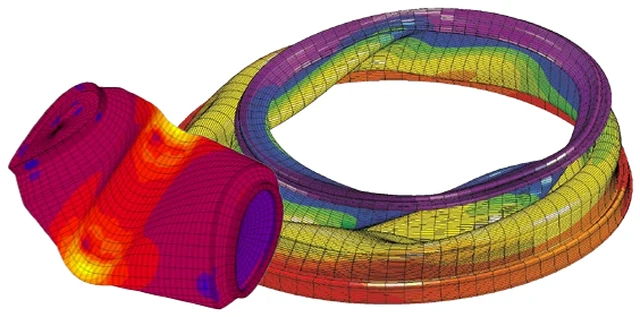
Stress contour on a large-deformation rubber-like torus component
A large-strain, hyperelastic material example — the class of problem Marc's nonlinear material library is built to solve.
03

Material Nonlinearity

Real engineering materials rarely behave as simple linear elastic solids once pushed toward their operating limits. Marc's material library covers isotropic and anisotropic plasticity with multiple yield criteria, time-dependent creep and stress relaxation, elastomer models for rubber gaskets and seals, viscoelastic damping, shape memory alloys, and layered composite and potting-compound behavior — all with temperature and rate dependence built in. For composite or filled-plastic components, Marc's nonlinear material models can also be populated with calibrated data from Digimat rather than generic handbook properties.

Typical Industries
Transformer gaskets and seals, EV motor potting and encapsulation, power module molding compounds, elastomer mounts and bushings.
Expected Outputs
Plastic strain and permanent set, creep strain over time, hyperelastic stretch and strain energy, temperature-dependent stress-strain response.
Design Decisions Enabled
Confirming a seal or potting compound stays within its elastic working range across its full service-temperature band.
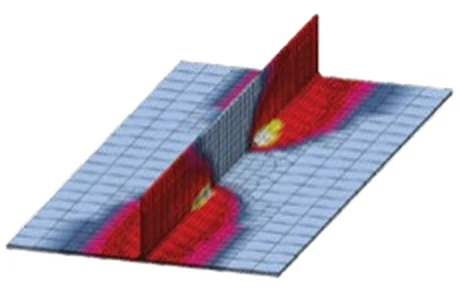
3D surface plot of heat flux across two contacting components
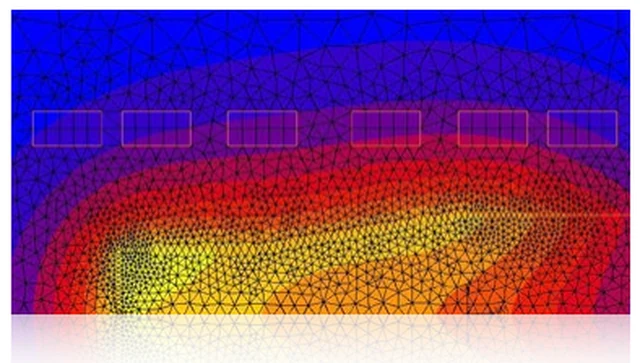
Heat flux across a contacting-component interface — the coupling that often produces the largest stresses in hardware that runs hot.
04

Thermal-Structural Coupling

Thermal-structural coupling takes a temperature distribution — whether computed in Marc's own heat-transfer solver or imported from an external thermal or CFD tool — and computes the stress and deformation that temperature field induces through thermal expansion and temperature-dependent material properties. A transformer's core, windings, and tank all expand at different rates as it heats up; an EV motor's air-gap changes as the stator and rotor grow thermally at different rates; a power module's board, solder, and package all expand differently under thermal cycling.

Typical Industries
Transformer core, winding and tank structures; EV motor stator, rotor and housing; power electronics PCB and package assemblies.
Expected Outputs
Thermally induced stress and displacement fields, air-gap and clearance variation, hot-spot and thermal-gradient location.
Design Decisions Enabled
Choosing clearances, mounting compliance, and material CTE pairings that accommodate thermal growth without cracking or binding.
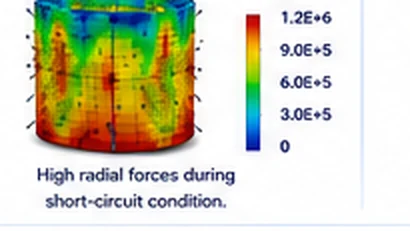
Radial electromagnetic force contour on a cylindrical transformer winding model
Radial electromagnetic force on a transformer winding under short-circuit condition — the structural consequence of an electromagnetic event.
05

Electromagnetic-Thermal-Structural Coupling

Marc solves coupled electromagnetic problems directly — Joule heating, induction heating with a staggered harmonic-electromagnetic-then-thermal approach, and magnetostatic analysis that computes Lorentz forces on conductors — and carries the resulting heat and force fields through into a full thermal-stress solution. This is the capability that most directly explains why Marc sits downstream of an electromagnetic design tool: a Maxwell, JMAG, or Flux model predicts the magnetic forces and induced currents, and Marc converts those into the structural consequence.

Typical Industries
EV traction motor magnet and sleeve systems, transformer winding and core assemblies under short-circuit loading, induction-heated components.
Expected Outputs
Induced current and heat flux, magnetic force distribution on structural components, coupled thermal-electromagnetic-structural stress.
Design Decisions Enabled
Verifying magnet retention and winding support hold under peak electromagnetic force events, not just steady-state load.
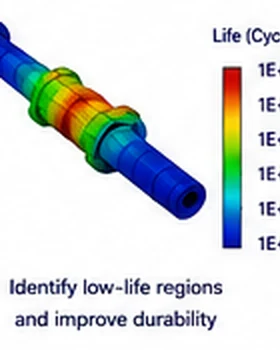
Fatigue life contour on a stepped shaft showing a low-life band at a shoulder
Fatigue life on a stepped shaft, showing a concentrated low-life band at a shoulder — exactly the kind of location a duty-cycle fatigue study is meant to flag.
06

Thermal Cycling, Fatigue & Crack Propagation

Reliability failures in motors, power electronics, and transformers are rarely single-overload events — they accumulate over thousands of thermal and mechanical cycles. Marc combines its structural and thermal-structural results with damage models and automatic crack-growth capability that can restart a solution after crack initiation to trace propagation through the mesh. Delamination in composite laminates and solder-joint or die-attach fatigue in electronic packages use the same underlying fatigue-and-damage framework, applied to interfaces instead of bulk material.

Typical Industries
EV motor shaft and rotor components, transformer winding supports and clamping structures, semiconductor package solder joints.
Expected Outputs
Cycles-to-crack-initiation, damage accumulation maps, predicted crack growth path, delamination risk at bonded interfaces.
Design Decisions Enabled
Prioritizing which locations need geometry change, material substitution, or process control to meet a target service-life requirement.
Mesh fringe plot showing localized mesh refinement at a jointed contact interface
Localized mesh refinement at a jointed interface — the level of detail Marc's process simulation carries into the resulting residual-stress state.
07

Manufacturing Process Simulation

A part's structural performance in service is affected by what happened to it during manufacturing — residual stress from forming or welding, shrinkage and cure stress in molded or potted components, or distortion from a shrink-fit assembly step. Marc simulates these processes directly: sheet and bulk forming, composite cure with coupled thermal-mechanical residual stress prediction, welding-induced deformation, and bolt or press-fit assembly sequences — with the resulting residual stress state available to carry forward as the starting condition for a subsequent structural or fatigue analysis.

Typical Industries
Stamped and formed automotive and motor housing components, potted and molded electronic packages, welded transformer tank structures.
Expected Outputs
Residual stress and strain distribution, predicted spring-back or shrinkage, post-process deformed shape.
Design Decisions Enabled
Accounting for manufacturing-induced stress and distortion in the reliability assessment instead of starting from an idealized geometry.
08

Adaptive Meshing & High-Performance Nonlinear Solvers

Severe deformation, contact, and forming problems can distort a finite element mesh badly enough that results become inaccurate or the solution simply stops converging. Marc's automatic adaptive meshing detects this during the run and generates a new, well-formed mesh from the deformed geometry, transferring stress, strain, and contact state onto it without user intervention — repeating as many times as the analysis needs. On the performance side, Marc's domain-decomposition method parallelizes every phase of the solution — input, matrix assembly, solving, stress recovery, and output — across shared-memory or distributed-memory hardware, plus GPU acceleration, so large nonlinear coupled models remain practical to run.

Typical Industries
Any nonlinear reliability study involving large assemblies, severe contact, or manufacturing-process simulation across automotive, energy, and electronics.
Expected Outputs
A converged solution on a distorted or evolving mesh; solve-time and scalability data across available cores or nodes.
Design Decisions Enabled
Making full-assembly, coupled-physics reliability studies practical within a development schedule, rather than relying on simplified sub-models.
Typical Workflow

How these capabilities connect in practice

A Marc study rarely uses one capability in isolation — it moves through a defined sequence, connecting upstream electromagnetic and thermal tools to downstream structural and fatigue results.

Import geometry and electromagnetic/thermal loads

CAD geometry is imported in native or neutral format and meshed; temperature fields, induced currents, or electromagnetic forces computed upstream in a tool such as Maxwell, JMAG, Motor-CAD, or a CFD package are brought in as the loading environment for the structural model.

A fully meshed multi-part engine-block assembly
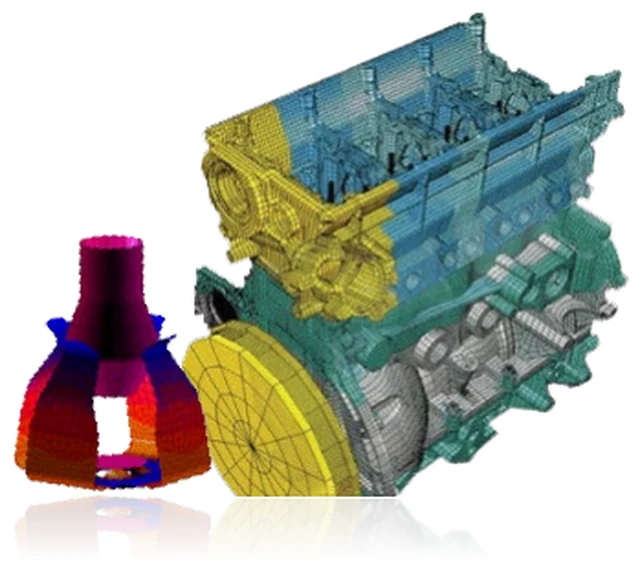
A fully meshed multi-part assembly — the geometry-to-model step every Marc study starts from, ready for adaptive remeshing if deformation becomes severe.

Define materials, contact, and boundary conditions

Nonlinear material models are assigned — plasticity, creep, hyperelastic, composite, or Digimat-supplied properties — and contact bodies are defined for interfaces that can touch, separate, or slide, such as shrink-fits, gaskets, or bearing seats.

Select the coupled solution sequence

The analyst chooses which physics need to be solved together — structural-only, thermal-structural, or fully coupled electromagnetic-thermal-structural — based on which effects actually drive the failure mode in question.

Solve, with adaptive meshing and parallel processing as needed

The nonlinear solver runs incrementally, using automatic remeshing if deformation becomes severe and domain-decomposition parallel processing across available cores, nodes, or GPUs to keep large coupled models tractable.

Post-process stress, deformation, and fatigue results

Contour plots, path plots, and time-history results are reviewed in Marc's integrated post-processor; structural results feed fatigue and damage models to predict cycles to crack initiation.

Correlate and iterate

Results are compared against test data where available and fed back into design changes — sleeve thickness, gasket compression, winding support stiffness — before the next physical prototype is built.

Applications by Industry

Where these capabilities are put to work

Meshed wheel and rim assembly with radial stress fringe
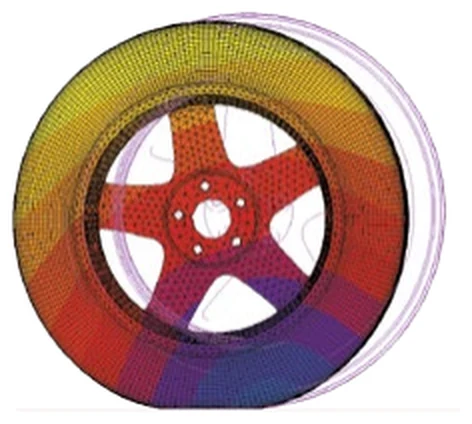
Rolling-contact and rotating-component stress evaluation — recurring problems across EV traction motors and driveline hardware.

Automotive / EV Powertrain

Rotor and magnet retention under centrifugal and electromagnetic load, burst-speed safety margin, air-gap variation from thermal expansion, shrink-fit assembly stress, and fatigue life of shafts and housings.

Von Mises stress contour on a dry-type transformer core and winding assembly
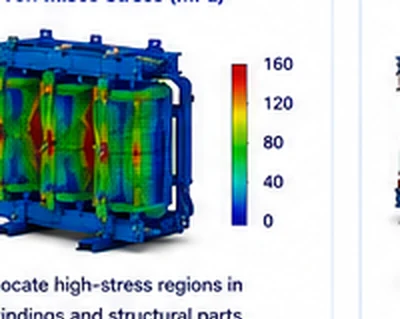
Core-and-winding stress under normal and short-circuit load conditions, across oil-filled and dry-type transformer designs.

Power & Energy / Transformers

Winding deformation under short-circuit electromagnetic force, thermal expansion and clamping-pressure loss in core and winding assemblies, gasket sealing and tank structural integrity.

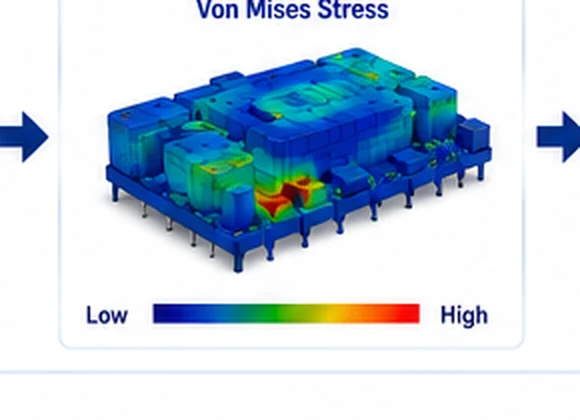
Von Mises stress contour on a populated PCB and power module assembly
Board- and package-level stress under thermal cycling — the resolution needed to trace solder-joint and die-attach fatigue risk.

Electronics / Semiconductor Packaging

Thermal-mechanical stress and warpage in IC packages and power modules; die attach, solder joint, and interconnect fatigue under thermal cycling; delamination risk at mold-compound interfaces.

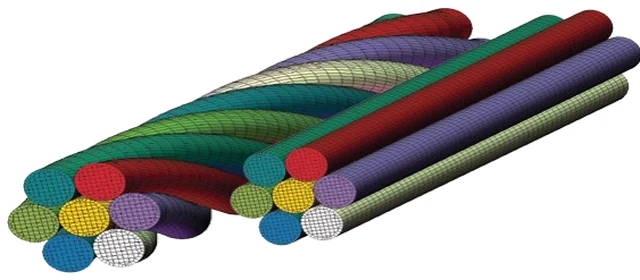
Meshed bundle of parallel cylindrical strands in contact
Multi-body contact between adjacent components — a recurring pattern in bundled, bolted, and pressure-fit industrial assemblies.

Industrial Machinery & General Manufacturing

Forming, welding, and assembly process simulation for stamped, forged, and welded components; gasket and seal performance in pressure equipment; general bolted-assembly contact reliability.

Interoperability

Where Marc fits in a wider simulation stack

Marc structural results export as DMIG files for direct compatibility with Nastran, and as Modal Neutral Files — including nonlinear preload effects — for import into Adams multibody models. Digimat supplies calibrated composite, plastic, and potting-compound material models directly into Marc's nonlinear material library. Cradle CFD and other thermal/CFD tools provide the convective boundary conditions that feed Marc's thermal-structural coupling studies. Actran takes Marc's structural vibration results as the excitation source for downstream vibro-acoustic analysis.

Exchanges structural data directly through DMIG files; typically used alongside Marc for the linear and moderately nonlinear portions of a broader study.

Supplies calibrated composite, plastic, and potting-compound material models directly into Marc's nonlinear material library.

Provides convective boundary conditions and temperature fields that feed Marc's thermal-structural coupling studies.

Imports Marc's flexible-body results as Modal Neutral Files, including nonlinear preload effects, for multibody durability studies.

Takes Marc's structural vibration and deformation results as the excitation source for vibro-acoustic and radiated-noise analysis.

FAQ

Frequently asked technical questions

How is Marc different from Nastran, since GTECH ASIA supplies both?

Nastran covers the full range from linear statics through dynamics and includes its own nonlinear solution sequences; Marc is a dedicated nonlinear specialist built specifically for the most severe contact, large-deformation, and material-nonlinearity problems, and the two solvers exchange data directly through DMIG files. In practice, Marc is typically brought in for the reliability-critical nonlinear and coupled-physics cases that sit beyond what a general-purpose linear or moderately nonlinear structural solve can represent accurately.

When does an EV motor, transformer, or electronics reliability question actually require nonlinear analysis instead of a linear check?

Whenever the load path depends on contact that can open or close (shrink-fits, bearing seats, gasket faces), whenever the material is pushed into plastic, viscoplastic, or hyperelastic behavior, or whenever deformation is large enough to change stiffness — all common, not exceptional, conditions in rotor sleeves, transformer windings under short-circuit load, and potted electronic packages.

How does Marc combine electromagnetic forces and heat with structural results?

Through coupled electromagnetic-thermal-structural analysis: Marc solves for induced current, magnetic force, and Joule or induction heating, then carries those loads directly into a thermal-stress solve — so a motor's magnet stress or a transformer's winding force reflects the actual electromagnetic loading environment, not a simplified static load case.

How does Marc handle models that become severely distorted during a nonlinear solve?

Through automatic adaptive meshing: when elements become too distorted for accurate results, Marc generates a new mesh from the deformed boundary, transfers the stress, strain, and contact state onto it, and continues the solution — repeated as many times as needed without user intervention.

Where does material data for nonlinear models come from?

From Marc's built-in curve-fitting tools for metals and elastomers, from calibrated composite and plastic models supplied by Digimat, or from temperature- and rate-dependent test data entered directly — covering plasticity, creep, hyperelasticity, viscoelasticity, and composite progressive-failure models.

Does Marc work with the electromagnetic and thermal tools our motor or transformer design team already uses?

Yes. Marc is designed to sit downstream of electromagnetic tools such as Maxwell, JMAG, and Flux and thermal/CFD tools such as Motor-CAD or Cradle CFD, taking their force and temperature outputs as the loading environment for the structural and fatigue analysis, rather than requiring the electromagnetic or thermal design to be rebuilt inside Marc.

GTECH ASIA supplies and supports Marc licensing for engineering teams across Malaysia and Southeast Asia, with HRD Corp certified training available for teams building in-house nonlinear analysis capability.