
Cadence · AI/ML Predictive Modeling Platform

ODYSSEE: AI-Driven Predictive Modeling for Engineering Simulation

ODYSSEE learns from the CAE, test, and sensor data engineering teams already have, and turns that history into a fast predictive model — so most design variants can be evaluated in seconds instead of re-run through a full physics solver. This page works through what the platform actually does, capability by capability, as a technical reference rather than a product pitch.

Platform ClassAI/ML predictive modeling platform for engineering simulation
DeveloperCadence Design Systems
Core CapabilitiesSurrogate/reduced-order model generation, instant prediction, design optimization, digital twin enablement
Data SourcesExisting CAE solver results, physical test data, in-service sensor data
Typical DeploymentLayered on top of an existing simulation process — from early design exploration through production digital twins
Overview

What ODYSSEE actually is

ODYSSEE is not a physics solver. It doesn't mesh geometry, apply boundary conditions, or integrate governing equations the way Nastran, Marc, or Cradle CFD do. Instead, it is a machine-learning layer that sits on top of the results those solvers — and physical testing and field sensors — already produce. It looks at a set of prior simulation runs, test measurements, or sensor logs, learns the statistical relationship between a design's input parameters and its resulting engineering response, and builds a predictive model — commonly called a surrogate model or reduced-order model (ROM) — that approximates that relationship directly. Once trained, the surrogate model can be queried for a new design variant in seconds, without re-running the original solver.

This is a fundamentally different way of getting an answer, not a faster version of the same answer. Running Nastran, Marc, or Cradle CFD directly gives a high-fidelity, physics-based result for one specific configuration, at the computational cost that configuration requires — minutes to hours per run, scaled up further across a design study. Running ODYSSEE gives a statistically inferred result for any configuration inside (or near) the range the model was trained on, at a fraction of the cost, because the expensive physics only had to be solved for the limited set of training cases. The trade is fidelity-per-run for the ability to evaluate far more variants than a full-physics campaign could ever afford — which is why ODYSSEE is described as supporting any solver, any physics, and any engineering discipline: it works from the output data those tools generate, not from re-implementing the underlying physics itself.

Because of this, ODYSSEE is deployed alongside a solver-based simulation process, not instead of it. A typical program still runs Nastran, Marc, Cradle CFD, or Digimat to generate the trusted, physics-accurate training data and to periodically validate the surrogate model's predictions. ODYSSEE's role is to extend the reach of that data — turning a limited set of high-fidelity runs into thousands of instantly evaluable design points for exploration, optimization, sensitivity studies, and, once deployed, real-time digital twin prediction.

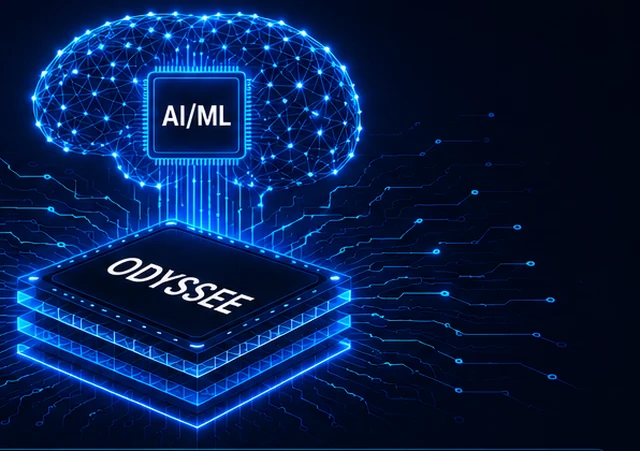
Conceptual illustration of an AI/ML neural network feeding into an ODYSSEE processor
ODYSSEE's role: an AI/ML layer that learns from existing CAE, test, and sensor data rather than solving physics directly.
Capabilities

Seven core capabilities, explained

Each capability below is a distinct function inside ODYSSEE. For each one: what it solves, why engineering teams reach for it, the industries that depend on it most, the results it produces, and the design decisions those results are actually used to make.

01

Surrogate Model Generation from Existing CAE, Test & Sensor Data

ODYSSEE's core function is building a surrogate (reduced-order) model from data an engineering team already has or can generate economically: prior CAE solver results, physical test measurements, and in-service sensor logs. Rather than treating each of these as a one-off result, ODYSSEE treats them as training data — using supervised and unsupervised machine learning to capture the underlying relationship between design or operating parameters and the resulting engineering response. The result is a compact, queryable model that reproduces the behavior captured in the training set without re-solving the original physics for every new query. This is the step every other ODYSSEE capability depends on: prediction, optimization, and digital twin deployment all consume the surrogate model this step produces.

Typical Industries
Automotive, aerospace, electronics, industrial machinery — any domain with an existing library of CAE, test, or sensor data.
Expected Outputs
A trained surrogate/reduced-order model mapping input parameters to engineering response.
Design Decisions Enabled
Deciding which existing data is worth reusing as a predictive asset rather than a single historical result.
02

Instant Design Variant Prediction

Once a surrogate model is trained, it can predict the engineering response for a new, previously unrun design variant almost instantly — a query that would otherwise require a fresh Nastran, Marc, or Cradle CFD run measured in minutes to hours. This is the capability that makes ODYSSEE useful for day-to-day design iteration: an engineer can change an input parameter and see a predicted response immediately, rather than queuing another solver job and waiting for it to return. Accuracy is bounded by how representative the training data is of the new query point, which is why validation against held-out data is a standard part of deployment rather than an optional check.

Typical Industries
Automotive, aerospace, electronics, industrial machinery.
Expected Outputs
Predicted engineering response (stress, displacement, thermal, NVH, or other solver-derived metric) for a new design configuration.
Design Decisions Enabled
Screening far more design variants early, before committing solver time to the most promising few.
03

Design Space Exploration & Multi-Objective Optimization Support

Because a trained surrogate model can be queried near-instantly, it becomes practical to explore a design space far more broadly than a solver-only process would allow — sweeping thousands of parameter combinations, running sensitivity analysis to identify which inputs actually drive the response, and feeding a multi-objective, multi-constraint optimization loop with real, integer, or categorical design variables. Traditional optimization against a full-physics solver is limited by how many runs a schedule and compute budget can absorb; a surrogate model removes that ceiling for the design-space-search step, while the solver is still used to confirm the optimizer's final candidates.

Typical Industries
Automotive, aerospace, electronics, industrial machinery.
Expected Outputs
Sensitivity rankings of design drivers, Pareto-style trade-off sets, optimized design parameter combinations.
Design Decisions Enabled
Converging on a near-optimal design configuration before committing further physics-based verification runs to it.
04

Solver- and Discipline-Agnostic Data Ingestion

ODYSSEE is built to learn from data rather than to re-implement any particular solver's physics, which is why it is positioned as supporting any solver, any physics, and any data format. In practice this means it can be trained on structural results from Nastran or Marc, thermal or flow results from Cradle CFD, material-informed results involving Digimat, physical test measurements, or field sensor streams — separately or combined — without requiring the underlying solvers to share a common format or workflow. This data-agnostic position is what lets ODYSSEE sit across an existing, heterogeneous simulation and test toolchain instead of forcing a team onto a single vendor's data pipeline.

Typical Industries
Automotive, aerospace, electronics, industrial machinery.
Expected Outputs
A unified training dataset assembled from multiple solver, test, and sensor sources.
Design Decisions Enabled
Reusing data already generated across disconnected tools and teams instead of duplicating simulation effort.
05

HPC Cost & Simulation Time Reduction

Every prediction served by a trained surrogate model is a query against a model, not a new finite-element or CFD solve — so it consumes a small fraction of the compute, licensing, and HPC queue time a full solver run requires. For programs where design studies are bottlenecked by HPC capacity or solver licensing seats, this shifts the cost profile: the expensive compute is concentrated in generating the initial training dataset, while the much larger number of downstream design evaluations run at comparatively low cost. This does not eliminate the need for HPC or solver licenses — the training data still has to be generated by real solver runs — but it changes how many additional runs a broader design study actually requires.

Typical Industries
Automotive, aerospace, electronics, industrial machinery.
Expected Outputs
A reduction in the number of full solver runs and associated HPC hours needed per design study.
Design Decisions Enabled
Justifying broader design exploration within a fixed compute or licensing budget.
06

Digital Twin & Real-Time Engineering Enablement

Because a trained surrogate model returns a prediction fast enough for interactive or streaming use, it can be embedded downstream of the original engineering study — for example, driving a digital twin that predicts a physical asset's structural, thermal, or dynamic response in real time from live sensor inputs, or supporting virtual prototyping and co-simulation across multiple physics domains. A physics-based solver is not built to run inside that kind of real-time loop; a lightweight, pre-trained surrogate model is. This extends the value of the original CAE and test investment well past the design phase, into monitoring and operational decision support.

Typical Industries
Automotive, aerospace, electronics, industrial machinery.
Expected Outputs
A deployable, low-latency predictive model suitable for real-time or embedded use.
Design Decisions Enabled
Supporting health monitoring, virtual prototyping, or in-service performance prediction without re-running a solver on live data.
07

Accuracy Validation Against Held-Out Data

A surrogate model is only as trustworthy as its validation, so ODYSSEE's workflow includes checking trained predictions against simulation, test, or sensor data that was withheld from training — data the model has not already seen — as well as robustness studies that evaluate how predictions hold up under input variation and uncertainty. This is the step that distinguishes a production-ready predictive model from an unverified curve fit: it tells an engineering team, in quantitative terms, how much confidence a given prediction deserves, and where the model's coverage of the design space starts to thin out.

Typical Industries
Automotive, aerospace, electronics, industrial machinery.
Expected Outputs
Correlation metrics between predicted and held-out actual results, robustness and uncertainty assessments.
Design Decisions Enabled
Deciding which predictions can be acted on directly and which still warrant a confirming solver run.
Typical Workflow

How these capabilities connect in practice

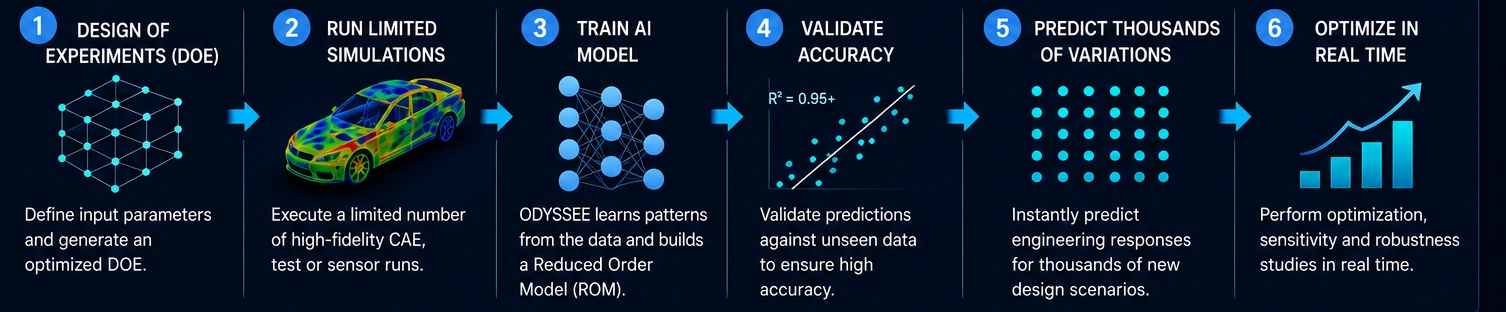
An ODYSSEE deployment moves from data aggregation through training and validation to instant prediction and, eventually, production deployment.

Six-step machine learning workflow diagram: design of experiments, run limited simulations, train AI model, validate accuracy, predict thousands of variations, optimize in real time
The six-step machine learning workflow ODYSSEE follows, from a limited set of high-fidelity runs to real-time optimization.

Aggregate existing CAE, test, and sensor data

Collect the CAE solver results, physical test measurements, and sensor logs already available for the design or asset in question, and define the input parameters that vary across them.

Fill gaps with a limited, targeted set of new runs

Where the existing dataset doesn't adequately cover the design space, run a small, well-chosen set of additional high-fidelity CAE, test, or sensor cases to fill it in — far fewer than a full design-of-experiments sweep would otherwise require.

Train the predictive (surrogate) model

ODYSSEE learns the relationship between input parameters and engineering response from the aggregated dataset, producing a reduced-order model that approximates the original physics.

Validate against held-out results

The trained model's predictions are checked against data withheld from training to confirm accuracy and identify where the model's confidence is lower.

Deploy for instant prediction and design exploration

Engineers query the validated model directly for new design variants, sensitivity studies, and multi-objective optimization — evaluating far more configurations than a solver-only process could support.

Integrate into a digital twin or retrain as new data arrives

For production or in-service use, the model is embedded into a digital twin or monitoring workflow, and retrained periodically as new simulation, test, or sensor data becomes available.

Applications by Industry

Where these capabilities are put to work

Automotive

ODYSSEE is used to accelerate structural, crash, NVH, thermal, and durability studies that would otherwise require large batches of solver runs across body, chassis, powertrain, and e-mobility/battery design variants, and to support digital twin monitoring of vehicle systems in service.

Aerospace

Surrogate models trained on structural, aerodynamic (CFD), and thermal simulation data support faster exploration of airframe, control system, and flight dynamics design variants, reducing the compute burden of certification-scale design studies.

Electronics

ODYSSEE learns from PCB integrity, power integrity, EMI/EMC, and thermal management simulation results to predict electronics reliability and performance across design variants without re-running a full solver stack for each one.

Industrial Machinery

Structural, vibration, dynamics, and multiphysics simulation data trains predictive models that support faster design iteration and system reliability assessment for industrial and heavy equipment, and can be deployed as digital twins for operational health monitoring.

Interoperability

Where ODYSSEE fits in a wider simulation stack

ODYSSEE does not replace GTECH ASIA's solver products — it learns from the results they produce and extends what a team can do with that data. Its data-agnostic ingestion means it is not limited to the GTECH ASIA product line: it can train on results from any CAE solver, physical test data, or field sensor stream a team already has.

Structural, dynamic, and thermal simulation results serve as training data for surrogate models covering stress, displacement, and vibration response.

Nonlinear structural and material-behavior results contribute training data for predictive models where large deformation or nonlinear response is part of the design question.

Flow and thermal simulation results train surrogate models for cooling, thermal management, and fluid-dynamics-driven design studies.

Material-informed structural results involving composite and plastic material models can be included in the training dataset for design variants sensitive to material behavior.

Any Solver, Test Rig, or Sensor Source

Data-agnostic ingestion means training data can come from any CAE solver, physical test, or field sensor stream a team already has, not only GTECH ASIA's own product line.

FAQ

Frequently asked technical questions

How much training data does ODYSSEE actually need?

There's no fixed number — it depends on the complexity of the design space and how nonlinear the underlying response is. In practice, teams start with a limited, well-distributed set of existing or newly run high-fidelity CAE, test, or sensor cases (a design-of-experiments approach is commonly used to choose them efficiently) rather than the hundreds or thousands of runs a brute-force solver sweep would require.

How accurate are ODYSSEE's predictions compared to running the full solver?

Accuracy is validated by comparing the trained model's predictions against solver, test, or sensor data withheld from training, and depends on how well the training set covers the design space being queried. Predictions close to the training data's coverage are typically reliable; predictions far outside that coverage should be treated cautiously and confirmed with an actual solver run.

Does ODYSSEE replace Nastran, Marc, or Cradle CFD?

No. ODYSSEE learns from the results those solvers produce; it doesn't replace the physics-based solve itself. Training data still has to come from real solver runs, physical tests, or sensor measurements, and periodic solver runs remain the way a surrogate model's predictions get validated and refreshed.

What kind of engineering response can ODYSSEE predict?

Whatever response is present in the training data — structural stress and displacement, thermal fields, vibration and NVH metrics, CFD-derived flow or thermal results, or other solver-derived outputs — since ODYSSEE is not tied to a specific physics discipline or solver.

Can ODYSSEE be used for real-time or in-service applications, not just design-phase studies?

Yes. A trained surrogate model is lightweight enough to run in real time, which is what makes it suitable for digital twin deployment — predicting an asset's structural, thermal, or dynamic response continuously from live sensor input rather than only during the design phase.

Does the surrogate model need to be retrained as new data becomes available?

Yes, periodically. As new CAE runs, test results, or in-service sensor data accumulate — especially data covering conditions outside the model's original training range — retraining keeps the model's predictions aligned with current, validated data rather than relying indefinitely on the original training set.

GTECH ASIA supplies and supports ODYSSEE licensing for engineering teams across Malaysia and Southeast Asia, with HRD Corp certified training available for teams building in-house AI/ML predictive modeling capability.